
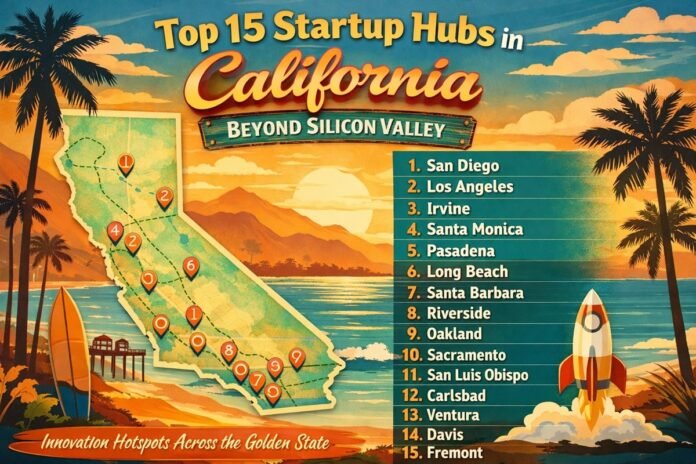
Last Updated: March 27, 2025 | Coverage: Top 15 California Startup Hubs Outside Silicon Valley Core
Meta description: Rank, compare, and decode 15 California startup hubs beyond Silicon Valley—with real 2024–2025 funding, talent, rent, and ecosystem data for founders. (156 chars)
Executive Summary
Purpose: Help startup founders, operators, and early employees evaluate, select, or relocate within California’s non-Silicon Valley hubs—using data, not myth—so they can optimize for burn rate, talent access, capital proximity, and sector fit.
Top 5 Key Insights
- San Francisco is still the global epicenter for AI. SF startups raised a record $111.7 billion in the first nine months of 2025 alone—45% of all U.S. venture capital—driven by OpenAI ($157B), Anthropic, and 800+ generative AI firms. [Growthlist / NVCA, 2025]
- Los Angeles is the #3 US ecosystem globally (#4 worldwide), the #2 market for AI funding ($1.8B, Q3 2024), and home to 500+ VC firms. BuildOps became LA’s newest unicorn in March 2025 after a $127M Series C. [Startup Genome, 2025]
- San Diego is the #2 US biotech cluster: ~2,000 life science companies, $3.37B in venture funding in 2024, 19.4% ecosystem growth in 2025, and lab space costs 40% below Boston. [Growthlist / SD Biotech Investors, 2025]
- Sacramento offers the highest capital efficiency in the Bay Area commutable zone—cost of living nearly 50% cheaper than Silicon Valley, 42,000 new tech jobs in 2024, and a GovTech + AgTech moat that few other hubs can replicate. [NuCamp / StartupSac, 2024–2025]
- California’s “second-tier” hubs are maturing fast: Pasadena launched its “Build It in Pasadena” deep tech campaign in 2025; Riverside’s SoCal OASIS secured $65M+ for an innovation hub; Irvine is building its first city-backed accelerator; and Long Beach launched a $25M venture fund. [Multiple sources, 2025–2026]
Quick Callouts
- Best-value hub for capital efficiency: Sacramento / Riverside — 40–50% lower SWE comp and 60%+ lower rent vs. SF
- Fastest-growing talent pool: Los Angeles — 13,600+ AI specialists; 13,000+ tech grads annually; 79% venture funding growth Q1 2024
- Strongest deep-tech cluster: Pasadena — Caltech + JPL pipeline; 20+ active VCs; Wilson Hill Ventures + Caltech Seed Fund
- Best for consumer startups: Los Angeles / Silicon Beach — entertainment IP, influencer economy, gaming studios, 10M+ consumer test market
- Most affordable coastal hub: Santa Cruz — UCSC talent pipeline, median 1BR ~$2,400, gaming/biotech ecosystem, 75 min from SF
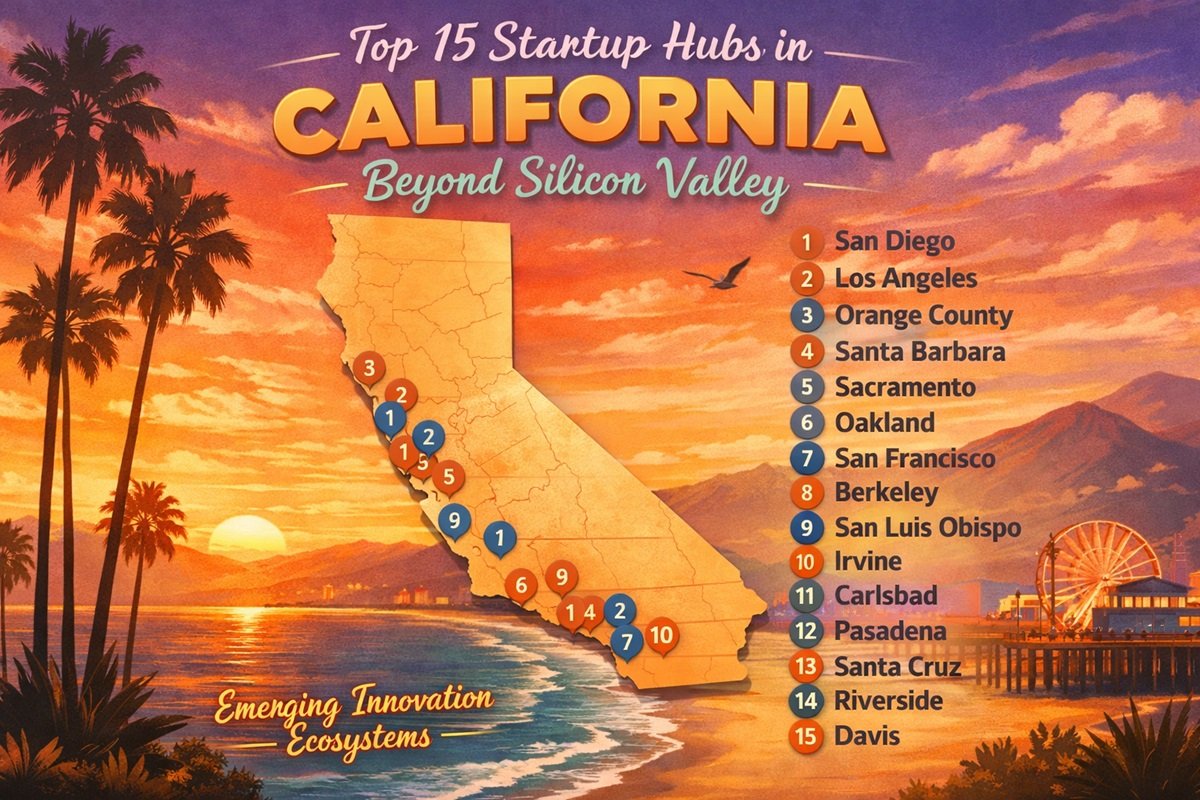
Quick Comparison Table: Top 15 Hubs
| Hub | One-Line Positioning | Notable Strengths | Key Risks | Best Fit |
|---|---|---|---|---|
| San Francisco | Global AI capital | AI/ML funding, talent density, VC access | Highest costs in CA; office vacancy 37% | Series A–C AI, enterprise SaaS |
| Los Angeles / Silicon Beach | #3 US startup ecosystem | Entertainment tech, defense, consumer, media | Traffic, inequality, fragmented geography | Seed–Series B: consumer, media, defense |
| San Diego | #2 US biotech cluster | Life sciences, defense, wireless | VC mostly outside region; high lab costs | Pre-clinical to Series B biotech/defense |
| Oakland / East Bay | Research-anchored alternative to SF | UC Berkeley, social impact, biotech | Crime/safety concerns, limited local VC | Pre-seed–Seed: biotech, social tech |
| Orange County / Irvine | SoCal medtech & SaaS hub | Medtech, SaaS, wireless, supply chain | Conservative culture; VC still growing | Seed–Series A: medtech, SaaS, wireless |
| Pasadena | Deep tech & space capital of SoCal | Caltech/JPL, photonics, robotics, AI | Small deal flow; limited late-stage capital | Pre-seed–Series A: deep tech, space |
| Sacramento | GovTech & AgTech gateway | State gov proximity, affordability, AgTech | Thin VC ecosystem, brain drain to SF | Seed–Series A: GovTech, AgTech, SaaS |
| Santa Barbara | Quantum & photonics corridor | UCSB, quantum, photonics, clean energy | Tiny ecosystem; lifestyle risk of isolation | Pre-seed–Seed: deep tech, clean energy |
| Long Beach | Logistics tech & aerospace rising hub | Port logistics, aerospace, diverse founders | Early-stage ecosystem; limited VC | Seed: logistics, proptech, aerospace |
| Riverside / Inland Empire | Most affordable Southern CA hub | UCR, warehousing tech, clean energy, diversity | Very thin capital access; far from VCs | Pre-seed: logistics, cleantech, social |
| Fresno / Central Valley | Emerging AgTech & FoodTech cluster | Lowest costs in CA; ag proximity | Nascent ecosystem; talent retention hard | Pre-seed–Seed: AgTech, food, GovTech |
| San Luis Obispo | Bootstrapped & climate-tech enclave | Cal Poly, clean energy, SaaS, lifestyle | Scale-up requires relocation | Pre-seed: SaaS, cleantech, agtech |
| Santa Cruz | Gaming & biotech niche hub | UCSC, gaming, biotech, ocean tech | Small market; limited office/lab supply | Pre-seed: gaming, biotech, ocean tech |
| Glendale / Burbank / SFV | Entertainment tech & aerospace district | Studios, aerospace, animation tech, media | Car-dependent; limited startup culture | Seed–Series A: media tech, aerospace |
| Ventura County | Defense & biotech corridor | Naval installations, Amgen, 101 Biotech | Small ecosystem; limited VC presence | Pre-seed: defense tech, biotech, clean |
Detailed Hub Profiles
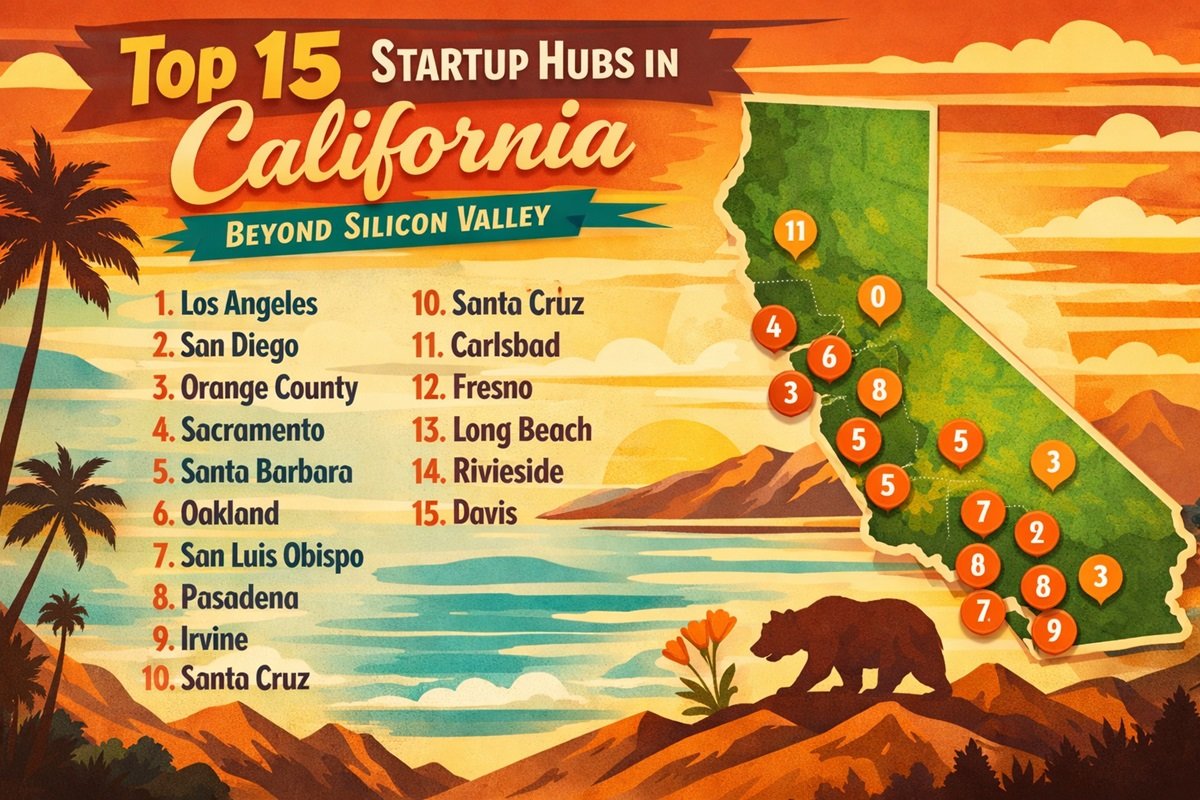
Hub 1: San Francisco — The Global AI Capital
Unrivaled funding density, unrivaled cost. Best for: Series A–C AI and enterprise SaaS.
Snapshot
San Francisco has reversed its pandemic-era narrative with overwhelming force. Startups in the SF metro raised $152.5 billion in 2025—65% above the previous all-time record—driven by OpenAI, Anthropic, Anysphere, Physical Intelligence, and hundreds of generative AI companies clustering in SoMa, Mission Bay, and Hayes Valley (“Cerebral Valley”). One in three U.S. venture dollars in Q3 2025 went to Bay Area companies. For founders who can afford it, SF offers irreplaceable network density and customer proximity.
Why It Matters for Startups
- Capital concentration: SF accounts for over 45% of all U.S. VC in 2025, with 268 active unicorns and VC firms managing $200B+ in assets. [NVCA/Crunchbase, 2025]
- AI talent density: 35% of all U.S. AI engineers are in the SF Bay Area; 27% of all startup engineers are here—more than 4x runner-up Seattle. [SignalFire Beacon, 2024]
- AI leasing revival: 1 in 4 sq ft leased in SF over the past 2.5 years went to AI companies; CBRE projects 16M additional sq ft of AI demand by 2030. [CBRE, 2025]
- Exit density: OpenAI (~$157B valuation), Databricks (expected $43B IPO), Stripe (potential 2026 IPO at $70B+). [Growthlist, 2025]
- Accelerator richness: Y Combinator ($500K for 7% + $375K uncapped SAFE), HF0, Berkeley SkyDeck ($200K for 7.5%), Alchemist. [Multiple, 2025]
Key Metrics
- VC funding (9 months 2025): $111.7B [NVCA/Growthlist, Oct 2025]
- Active unicorns: 268 companies [Growthlist, 2025]
- Office rent (Class A, SoMa): $60–90/sq ft/year [CBRE, 2025]
- Median 1BR rent (AI neighborhoods): ~$3,830 (up 30% YoY) [Zumper, Dec 2025]
- Median SWE salary: ~$175,000–$210,000+ [Glassdoor/Levels.fyi, 2025]
- Office vacancy rate: ~35.8% (recovering; projected <18% by 2030) [CBRE, Q1 2025]
- AI tenant demand: 7.9M sq ft sought in Q3 2025 (record) [CBRE, Nov 2025]
Costs
Pre-seed team of 2–3: $15–25K/month. Seed (5–10 people): $100–200K/month (salaries = 70–80% of burn). Series A (15–30 people): $400–800K/month. Office at $60–90/sq ft/year means a 5,000-sq-ft lease runs $25–40K/month. Founders must aggressively use subleases and coworking to manage burn. [Growthlist, 2025]
Talent & Pipeline
Stanford and UC Berkeley produce thousands of CS/engineering graduates annually. Big Tech alumni from Google, Meta, Apple, and OpenAI continuously launch startups. The pool of tech workers with AI skills jumped 50%+ nationally mid-2024 to mid-2025; SF/Bay Area accounts for the largest share. [CBRE, Sep 2025]
Capital & Ecosystem
Sequoia, a16z, Lightspeed, Greylock, NFX, and Khosla are all headquartered within 30 miles. Top accelerator pathways: Y Combinator, HF0, Alchemist, and Berkeley SkyDeck. Notable 2025 raises: OpenAI ($40B, largest private round in history), Anysphere ($2.3B Series D), Physical Intelligence ($600M), Mercor ($350M).
Notable Companies & Recent Wins (2024–2025)
- OpenAI: ~$157B+ valuation; SoftBank-led $40B round, March 2025
- Anysphere (Cursor): $2.3B Series D — AI developer tools
- Physical Intelligence: $600M robotics funding round
- Databricks: Expected $43B IPO; Stripe: Potential 2026 IPO at $70B+
Risks & Watchouts
- Highest cost of doing business in California — SWE comp 30–40% above LA or SD
- AI talent war: Engineers can command $250K–$400K+ total comp at frontier labs, pricing out smaller startups
- Office paradox: Trophy space tightening while 35%+ vacancy persists in older stock — negotiate hard for sublease deals
- Visa complexity: International founders face longer H-1B queues in a market dependent on global talent
Actionable Next Steps
- Coworking: WeWork (multiple SoMa/FiDi locations), Industrious (5 locations), Runway (Mission Bay)
- Accelerators: Y Combinator (ycombinator.com), HF0 (hf0.com), Berkeley SkyDeck (skydeck.berkeley.edu)
- Events: AI Tinkerers SF (weekly), SF AI/ML Meetup (10,000+ members), TechCrunch Disrupt
- Sub-lease hunting: CBRE and JLL SoMa/Mission Bay offices have active AI sublease inventory
- EDO Contact: SF Office of Economic and Workforce Development — oewd.org
Hub 2: Los Angeles / Silicon Beach — The Creative Capital
Entertainment, AI, defense, and consumer. Best for: Seed–Series B consumer, media, defense tech.
Snapshot
Los Angeles is the #3 startup ecosystem in the U.S. and #4 globally (2024 Global Startup Ecosystem Report), and it is accelerating. With $1.8 billion in AI venture funding in Q3 2024 alone (second only to SF), 500+ VC firms, and 42 active unicorns, LA’s ecosystem has matured into a genuinely diversified tech powerhouse. The region’s unique strengths lie at the intersection of entertainment, defense tech (Anduril, SpaceX), consumer brands, and a 10M+ population test market. BuildOps became LA’s newest unicorn in March 2025 after a $127M Series C.
Why It Matters for Startups
- Second-largest AI market: LA ranked #2 in U.S. for AI funding in Q3 2024 with $1.8B across 31 deals; 13,600 AI specialists — #4 in North America. [Startup Genome, 2025]
- VC ecosystem maturity: 500+ VC firms, including Upfront Ventures, Crosscut, Mucker Capital, Fika Ventures (raised $160M AI fund, Sep 2024), and a16z’s $30M Speedrun Gaming Accelerator (2024). [Startup Genome, 2025]
- Consumer & entertainment moat: Proximity to Hollywood, Riot Games, and Snapchat creates unmatched user acquisition labs for consumer apps.
- Defense tech corridor: Anduril Industries ($1.5B round, 2024), SpaceX, and the LA-area aerospace cluster provide government contract access impossible elsewhere. [Crunchbase, 2024]
- Talent scale: 13,000+ tech grads annually from UCLA, USC, CalArts, LMU; 300,000+ startup workforce. [Startup Genome, 2025]
Key Metrics
- VC funding (LA metro, 2024): ~$8–12B [Startup Genome / PitchBook, 2024]
- Active unicorns: 42 — only ecosystem globally to grow unicorns 2021–2023 [Startup Genome GSER, 2024]
- VC funding growth (Q1 2024): 79% YoY [Startup Genome, 2024]
- Median SWE salary: ~$140,000–$165,000 [Glassdoor, 2025]
- Office rent (Class A, Playa Vista/West LA): $50–75/sq ft/year [CBRE, 2024]
- Median 1BR rent (Santa Monica/Venice): ~$2,800–$3,400 [Zillow, 2025]
Costs
LA SWE salaries run ~15–25% below SF, providing meaningful runway advantages. Office in Playa Vista or Santa Monica runs $50–75/sq ft/year vs. $60–90 in SF. Residential in Culver City, Mar Vista, and El Segundo: $2,200–$2,700/month — more affordable than Venice/Santa Monica. Lab space available through LACI (Los Angeles Cleantech Incubator) and the USC/UCLA research corridors.
Talent & Pipeline
UCLA (CS ranked top 10 nationally), USC Viterbi School of Engineering, Loyola Marymount, and Cal State LA collectively produce 13,000+ tech graduates annually. LA’s cross-industry talent (entertainment + tech) is unique: data scientists who understand narrative, UX designers who understand culture. ArtCenter College of Design produces world-class product designers.
Capital & Ecosystem
Key VCs: Upfront Ventures, Crosscut, Mucker Capital, March Capital, Fika Ventures, TenOneTen, Bonfire Ventures, Luma Launch. Accelerators: a16z Speedrun (gaming), Techstars LA, Grid 110, LACI. Mayor Bass’s LA Optimized 2.0 reduced permit times by 25% in 2024. County’s $17M HRTP Fund launched March 2025 for workforce training.
Notable Companies & Recent Wins
- Anduril Industries: $1.5B funding round (2024); defense tech market leader
- BuildOps: Unicorn status, March 2025 ($127M Series C); construction tech
- Regard: $61M AI-powered clinical platform
- Pelage Pharmaceuticals: $120M Series B (biotech, 2025)
- TORL Biotherapeutics: $96M Series C (2025)
Risks & Watchouts
- Geographic fragmentation: Silicon Beach, DTLA, Pasadena, Culver City, and Long Beach are 30–60 minutes apart with no walkable startup district
- Senior AI/ML engineers often prefer SF; LA must differentiate on lifestyle and compensation
- Median home price >$900K; gentrification pressure creates political risk for employers
- 2025 fire recovery and regulatory uncertainty add business environment unpredictability
Actionable Next Steps
- Coworking: CrossCampus (multiple LA locations), WeWork (Playa Vista, Culver City), LACI (cleantech-focused)
- Accelerators: a16z Speedrun (a16z.com/speedrun), Techstars LA (techstars.com), Grid 110 (grid110.org)
- Events: TechDay LA, Silicon Beach Fest, LA Venture Association (LAVA) events, dot.LA Summit
- EDO Contact: LA County Economic Development Corporation — laedc.org
- Studio/Defense access: LACI (laincubator.org), SoCal Innovation Hub
Hub 3: San Diego — The Life Sciences Powerhouse
Biotech, defense, wireless. Best for: Pre-clinical through Series B life sciences and defense tech.
Snapshot
San Diego is the undisputed #2 U.S. biotech cluster (behind Boston/Cambridge), with nearly 2,000 life science companies generating $56 billion in economic output. The ecosystem grew 19.4% in 2025, ranking #25 globally and #9 in the U.S. Startups raised $3.37B in 2024 and over $3.6B in 2025. The Torrey Pines–La Jolla–Sorrento Valley corridor is one of the densest biotech corridors in the world, anchored by UCSD, the Salk Institute, Scripps Research, and Sanford Burnham Prebys. Lab space costs 40% less than Cambridge; talent accepts 20–30% lower comp than Boston.
Why It Matters for Startups
- Biotech capital efficiency: Average seed round ($8M) and Series A ($35M) are lower than Boston but competitive with SF biotech. [SD Biotech Investors, 2025]
- World-class research: Scripps Research, Salk Institute, J. Craig Venter Institute, and UCSD published 2,000+ peer-reviewed papers in 2023. [IntuitionLabs, 2025]
- Infrastructure pipeline: 3.2M sq ft of new lab and research space added by end of 2025; $1.6B IQHQ RaDD complex opened in Downtown SD. [IntuitionLabs, 2025]
- Defense tech adjacency: NAVWAR and Naval Base San Diego create a defense tech ecosystem rivaled only by Northern Virginia.
- Border advantage: Proximity to Tijuana/Ensenada enables cost-efficient scale-up for hardware/device companies.
Key Metrics
- VC funding (2024): $3.37B [Growthlist, 2025]
- Biotech deals (2025): 180 deals worth $4.8B [SD Life Sciences Investors, 2025]
- Life science companies: ~2,000 [IntuitionLabs, 2025]
- Ecosystem growth (2025): 19.4% [StartupBlink, 2025]
- Median SWE salary: ~$130,000–$155,000 [Glassdoor, 2025]
- Lab rent (Torrey Pines / La Jolla): $70–90/sq ft/year [IntuitionLabs / JLL, 2025]
- Office rent (Class A, Sorrento Valley): $40–55/sq ft/year [CBRE, 2024]
- Median 1BR rent (La Jolla / UTC): ~$2,600–$3,000 [Zillow, 2025]
Costs
San Diego is a “biotech value zone”: lab costs 40% below Cambridge, comp 20–30% below Boston. Median home price ~$825K (up 10% since 2022) — high for a mid-tier city, but affordable relative to SF. Torrey Pines premium lab space: $70–90/sq ft/year. Sorrento Valley office: $40–55/sq ft/year. The $1.6B IQHQ Pacific Center (690K sq ft, opened 2025) and Alexandria’s Campus Point megacampus are adding high-quality inventory.
Talent & Pipeline
UCSD ranks among the top 20 global universities and leads the nation in STEM graduates. Scripps Research, Salk, and UCSD collectively employ thousands of life science PhD researchers. JLABS San Diego has incubated 100+ startups; Biocom’s annual conference draws thousands of life science professionals. The 2024 BIO International Convention in SD had 18,000+ attendees.
Capital & Ecosystem
Key VCs: Avalon BioVentures, Foresite Capital, ARCH Venture Partners, Section 32, Versant Ventures, Red Tree Venture Capital, Qualcomm Ventures, BioMed Ventures. Key accelerators: JLABS San Diego (J&J Innovation), IndieBio, EvoNexus. Notable: Nerio Therapeutics acquired by Boehringer-Ingelheim for up to $1.3B (2024); Janux Therapeutics raised $750M+ total; Erasca raised $200M Series C (2025).
Notable Companies & Recent Wins
- Erasca: $200M Series C (oncology, 2025)
- Nerio Therapeutics: Acquired for up to $1.3B by Boehringer-Ingelheim (2024) — Avalon BioVentures portfolio
- Janux Therapeutics (JANX): $750M+ raised; >$3B public market valuation
- Element Biosciences: Series B genomics financing (2025)
- Turn Bio: $65M founding round (cellular reprogramming, 2025)
Risks & Watchouts
- “What’s missing is large, locally based venture capital. The investment committees are still in San Francisco and Cambridge.” — Daniel Bradbury, BioBrit; Series B+ funding gaps are real
- Rising costs: Median home price ~$825K (up 10% from 2022); Torrey Pines lab rents up 15% since 2021
- Wildfire risk: Two significant fires came within 10 miles of biotech hubs in 2023; business continuity planning is essential
- Biotech cycle dependence: 2022–2024 “valley of death” funding crunch hurt early-stage biotech; timing raises around public market windows is critical
Actionable Next Steps
- Lab space: JLABS SD (jlabs.jnjinnovation.com), Mira Mesa BioLabs, BioMed Realty campuses in Torrey Pines
- Accelerators: IndieBio SD (indiebio.co), CONNECT San Diego (connect.org), EvoNexus (evonexus.org)
- Events: San Diego Startup Week, BIO International Conference, Biocom Annual Conference
- EDO Contact: San Diego Regional EDC (sandiegobusiness.org); CONNECT (connect.org)
- Grants: NIH/SBIR, NSF, DoD SBIR — UCSD’s Tech Transfer Office facilitates applications
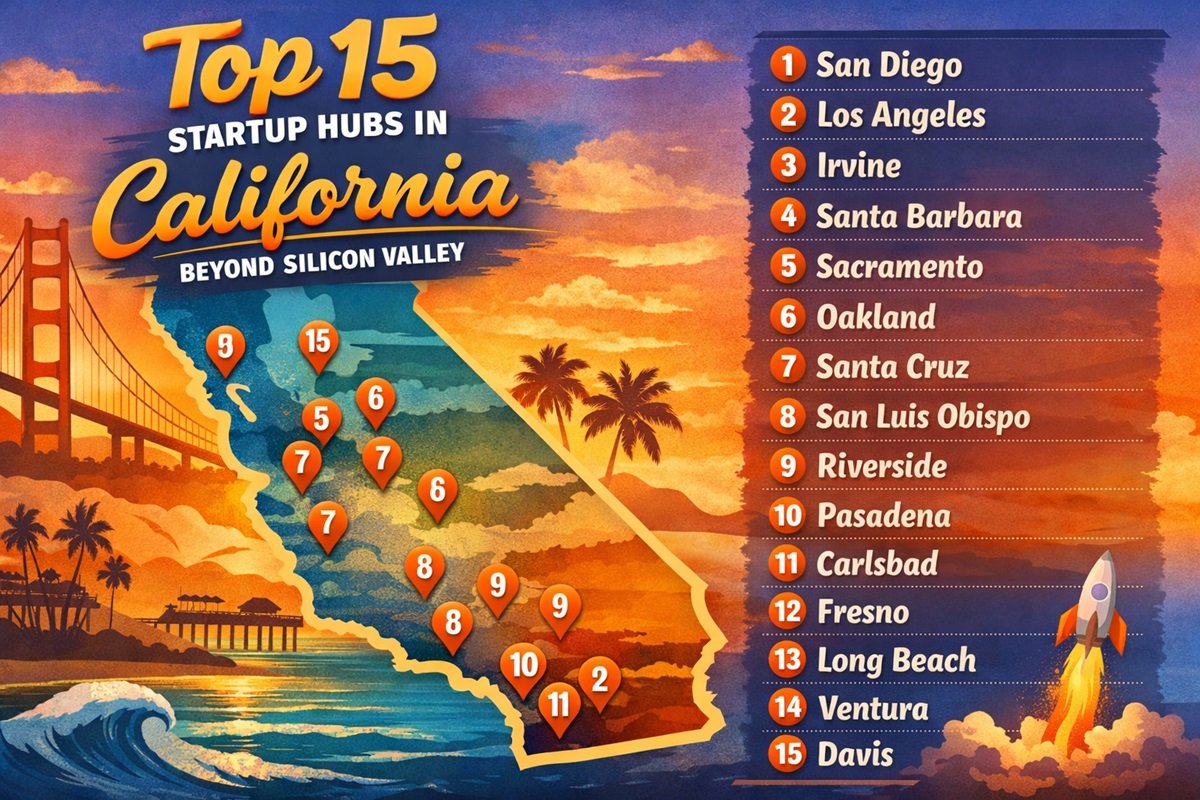
Hub 4: Oakland / East Bay — The Research Engine
UC Berkeley, biotech, social impact. Best for: Pre-seed–Seed biotech, sustainability, B2B SaaS.
Snapshot
The East Bay—anchored by UC Berkeley and Oakland’s innovation neighborhoods—is both a cost refuge from SF and an independent research powerhouse. Berkeley SkyDeck ($200K for 7.5%, 900+ investors at Demo Days) and QB3-Berkeley incubate hundreds of startups annually. The ecosystem skews toward social impact, sustainability, biotech, and B2B SaaS. BART connects Oakland to SF in 20 minutes, making the East Bay a practical base for founders needing SF investor access without SF rents. Freeflow Ventures (deep tech, $90M fund) explicitly expanded to Berkeley in 2024 to match its Caltech model.
Key Metrics
- Median SWE salary: ~$145,000–$170,000 [Glassdoor, 2025]
- Office rent (Class A, Oakland/Berkeley): $30–45/sq ft/year [CBRE/CoStar, 2024]
- Median 1BR rent: ~$2,100–$2,500 [Zillow, 2025]
- SkyDeck investment per cohort company: $200,000 for 7.5% equity [SkyDeck, 2025–2026]
- SkyDeck Demo Day investors: 900+ per event — largest in Bay Area [SkyDeck, 2025]
Actionable Next Steps
- Accelerators: Berkeley SkyDeck (skydeck.berkeley.edu), LAUNCH at Berkeley (launch.berkeley.edu), Free Ventures (freeventures.org)
- Lab space: QB3-Berkeley (qb3.org/berkeley), Berkeley BioLabs (berkeleybiolabs.com)
- Coworking: Impact Hub Oakland, Bespoke (Oakland), Runway (Oakland)
- EDO Contact: Oakland Economic Development — oaklandca.gov/topics/economic-development
Hub 5: Orange County / Irvine — SoCal MedTech & SaaS Hub
UCI Beall, Qualcomm legacy, B2B growth. Best for: Seed–Series A medtech, SaaS, wireless.
Snapshot
Orange County—centered on Irvine—is a mature, underrated startup hub punching above its weight in medical technology, B2B SaaS, and wireless. UCI Beall Applied Innovation @ the Cove draws 40,000–50,000 visitors annually and offers a community-first, no-cost incubator. The City of Irvine launched its Innovation Center initiative in February 2026, seeking a world-class accelerator operator. Tech Coast Angels (now TCA Venture Group, ~400 members) is one of the nation’s largest and most active angel networks—co-founded by UCI alumni. Irvine’s VC funding peaked at $4.6B in 2020, with healthcare innovation peaking at $2.4B in 2022.
Key Metrics
- VC funding peak (Irvine, 2020): $4.6B [BW Research / Crunchbase, 2024]
- Healthcare Innovation funding peak (2022): $2.4B [BW Research, 2024]
- Median SWE salary: ~$125,000–$150,000 [Glassdoor, 2025]
- Office rent (Class A, Irvine): $38–55/sq ft/year [CBRE, 2024]
- Median 1BR rent: ~$2,300–$2,700 [Zillow, 2025]
- TCA Venture Group members: ~400 across 6 networks [TCA, 2025]
Actionable Next Steps
- Hub: UCI Beall Applied Innovation @ the Cove (innovation.uci.edu)
- Investors: TCA Venture Group (tcaventuregroup.com), Cove Fund (covefund.com)
- Events: OC Innovation Week (annual, octaneoc.org)
- EDO Contact: Irvine Economic Development (irvine.org/business/economic-development)
Hub 6: Pasadena — Deep Tech Capital of SoCal
Caltech, JPL, photonics, robotics, quantum. Best for: Pre-seed–Series A deep tech and space.
Snapshot
Pasadena is California’s best-kept startup secret. Home to Caltech (#1 in physics and engineering) and NASA’s Jet Propulsion Laboratory (JPL), the city produces a disproportionate volume of deep tech spinouts in photonics, quantum, robotics, AI for scientific computing, and biotech. The City’s “Build It in Pasadena” campaign (launched February 2025) earned 1 million+ impressions and a 400% engagement surge in its first month. When Innovate Pasadena hosts events, 20+ VCs attend—from Kairos and Wilson Hill Ventures to Mandala Space Ventures. The AWS Center for Quantum Computing opened on the Caltech campus in 2024, validating the quantum cluster.
Key Metrics
- Caltech Seed Fund annual deployment: $1.5M/year; 4–6 investments at $100K–$500K each [Caltech OTTCP, 2025]
- Freeflow Ventures fund size: $90M (raised 2024; backed by Nobel laureate founders) [Pasadena Now, 2024]
- Innovate Pasadena VC network: 20+ VCs attending regular events [Caltech Magazine, 2022]
- Median SWE salary: ~$120,000–$145,000 [Glassdoor, 2025]
- Office rent (Class A): $35–50/sq ft/year [CBRE, 2024]
- Median 1BR rent: ~$2,000–$2,500 [Zillow, 2025]
- “Build It in Pasadena” impressions: 1M+ in first 30 days [City of Pasadena, Feb 2025]
Actionable Next Steps
- Caltech resources: Caltech Seed Fund & OTTCP (innovation.caltech.edu), Wilson Hill Ventures
- City support: “Build It in Pasadena” (cityofpasadena.net); Economic Development Director Dave Klug
- Community: Innovate Pasadena (innovatepasadena.org), Pasadena Angels (pasadenaangels.com)
- Events: Caltech Entrepreneurs Forum (monthly), Innovate Pasadena’s ConnectPasadena
Hub 7: Sacramento — GovTech Gateway & AgTech Capital
Affordable, growing, collaborative. Best for: Seed–Series A GovTech, AgTech, SaaS.
Snapshot
Sacramento is California’s most underestimated startup hub. As the state capital, its proximity to 180+ state agencies creates an unmatched GovTech moat. AgTech flourishes because of UC Davis and proximity to the Central Valley’s $50B+ farming economy. The startup community is known for collaborative mentorship over transactional networking. Cost of living is nearly 50% below Silicon Valley, tech job growth hit 2.7% (42,000 new jobs) in 2024, and the City invested $450K in startup grant programs in late 2024.
Key Metrics
- Cost of living vs. Silicon Valley: ~50% lower [NuCamp, 2025]
- Tech job growth (2024): 2.7% — ~42,000 new tech jobs [NuCamp, 2025]
- Tech companies in region: 1,400+ [NuCamp, 2025]
- Ecosystem size (StartupBlink, 2025): #97 globally; $706M+ total startup funding; +6.4% growth [StartupBlink, 2025]
- Median SWE salary: ~$110,000–$130,000 [Glassdoor, 2025]
- Office rent (Class A): $25–38/sq ft/year [CBRE, 2024]
- Median 1BR rent: ~$1,500–$1,800 [Zillow, 2025]
Actionable Next Steps
- Community: StartupSac (startupsac.com), Growth Factory (growthfactory.io), Sacramento Entrepreneurship Academy
- Accelerators: Carlsen Center Traction Lab (Sac State), Davis Roots (davisroots.org)
- Coworking: Hacker Lab (hackerlabsac.com), I/O Labs (downtown Sacramento)
- EDO Contact: Greater Sacramento Economic Council (choosesacramento.com)
Hub 8: Santa Barbara — Quantum & Photonics Corridor
UCSB, clean energy, Nobel science. Best for: Pre-seed–Seed deep tech and clean energy.
Snapshot
Santa Barbara is California’s most intellectually dense small-market hub. UC Santa Barbara has produced 6 Nobel Prize winners in physics and chemistry—many of them founders—and its California NanoSystems Institute (CNSI) Technology Incubator anchors a genuine quantum and photonics cluster. The city’s 200+ tech startups raised ~$300M in 2022. UCSB spinouts in photonic integrated circuits, RF chipsets, and clean energy hydrogen are attracting national attention. The CNSI incubator was expanded with 1,500 sq ft of new wet lab space in 2025 (funded by CA AB2664).
Key Metrics
- Startup count: 200+ tech startups [NuCamp, 2024]
- VC funding (2022): ~$300M [NuCamp, 2024]
- Median SWE salary: ~$105,000–$130,000 [Glassdoor, 2024]
- Office rent (Class A): $32–48/sq ft/year [CoStar, 2024]
- Median 1BR rent: ~$2,400–$2,800 [Zillow, 2025]
- UCSB Nobel Prizes (physics/chemistry): 6 [UCSB, 2024]
Notable Companies & Recent Wins
- Quintessent: Oversubscribed seed round (2024); photonic ICs for AI data centers
- PseudolithIC: $6M seed led by Entrada Ventures (2024); RF chipsets for wireless
- Apeel Sciences: UCSB spinout; $250M+ raised; plant-based food preservation leader
- Integrated Biosciences: $17M seed led by Sutter Hill Ventures (2024); longevity biotech
Actionable Next Steps
- UCSB resources: CNSI Technology Incubator (cnsi.ucsb.edu/innovation), TIA (tia.ucsb.edu), The Garage co-working, G2 Summer Accelerator
- Grants: NSF I-Corps, DOE SBIR, DARPA SBIR through UCSB TIA facilitation
- Events: Central Coast Innovation Awards (annual, CNSI + Pacific Coast Business Times), Startup Village (25-startup annual showcase)
Hub 9: Long Beach — Logistics & Aerospace Rising Hub
Port tech, proptech, emerging ecosystem. Best for: Seed logistics, aerospace, diverse founders.
Snapshot
Long Beach has the infrastructure assets of a major tech city—the nation’s #2 container port by volume, major aerospace manufacturers, and CSU Long Beach—but the funding ecosystem of an emerging hub. The Launch Beach 100 Startups Campaign (2024) created an 8-organization coalition backed by a $25M Long Beach Venture Fund, with Sunstone Management (ranked #7 most active early-stage VC by PitchBook Q2 2023) as general partner. The port’s position as the entry point for 40%+ of U.S. imports creates a world-class testbed for logistics tech startups.
Key Metrics
- Long Beach Venture Fund target: $25M [LBEP, 2024]
- Sunstone Management national ranking (Q2 2023): #7 most active early-stage VC (PitchBook) [LBEP, 2024]
- Median SWE salary: ~$115,000–$140,000 [Glassdoor, 2025]
- Office rent (Class A): $28–42/sq ft/year [CBRE, 2024]
- Median 1BR rent: ~$1,900–$2,400 [Zillow, 2025]
Actionable Next Steps
- Accelerators: Long Beach Accelerator (longbeachaccelerator.com), CSULB Innovation (csulb.edu/innovation)
- Funding: Long Beach Venture Fund (lbep.org/initiatives/launch-beach/)
- EDO Contact: Long Beach Economic Partnership (lbep.org)
Hub 10: Riverside / Inland Empire — Most Affordable SoCal Hub
Clean energy, logistics, diverse founders. Best for: Pre-seed logistics, cleantech, social impact.
Snapshot
The Inland Empire is California’s most affordable metropolitan region and its fastest-growing logistics and clean energy corridor. UC Riverside’s SoCal OASIS initiative has secured $65M+ in funding for an innovation hub focused on sustainability, clean tech, and social inclusion. CalOSBA’s Accelerate California program provides Inclusive Innovation Hub grants specifically targeting the IE. The region’s position at the convergence of the I-10, I-15, and I-215 freeways—serving as the warehousing backbone of Southern California—makes it uniquely suited for logistics tech startups.
Key Metrics
- UCR SoCal OASIS funding: $65M+ secured [NuCamp, 2024]
- CalOSBA Accelerate Hub grant (UCR): $1.293M over 5 years [Blended Impact, 2025]
- Median SWE salary: ~$95,000–$115,000 [Glassdoor, 2024]
- Office rent (Class A): $20–32/sq ft/year [CoStar, 2024]
- Median 1BR rent: ~$1,600–$1,900 [Zillow, 2025]
Actionable Next Steps
- Hub: UCR SoCal OASIS (ucr.edu/research/oasis), UCR Office of Technology Partnerships
- Programs: Accelerate California Inclusive Hub (calosba.ca.gov), Caravanserai Project (caravanseraiproject.org)
- SBDC: OC Inland Empire SBDC Network (ocsbdc.org) — 9 service centers, 125+ consultants
- EDO Contact: Inland Empire Economic Partnership (ieep.com)
Hub 11: Fresno / Central Valley — Emerging AgTech & FoodTech
Lowest CA costs, underserved market. Best for: Pre-seed–Seed AgTech, food, GovTech.
Snapshot
Fresno is California’s emerging frontier hub. Fresno County is the nation’s #1 agricultural county by value, and the Central Valley produces over $17 billion in California farm revenue annually—creating immediate pilot customer access for precision ag, irrigation tech, and food traceability startups. The James Irvine Foundation invested $1M in Fresno’s small business ecosystem through Small Business Majority (2024). Costs are California’s lowest: median 1BR ~$1,100–$1,400; SWE comp ~$85,000–$105,000; office rents as low as $15–25/sq ft.
Key Metrics
- Fresno County agricultural value: #1 agricultural county in the U.S. by value [USDA, 2023]
- James Irvine Foundation investment (2024): $1M for Fresno small business ecosystem [Blended Impact, 2025]
- Median SWE salary: ~$85,000–$105,000 [Glassdoor, 2024]
- Office rent: $15–25/sq ft/year [CoStar, 2024]
- Median 1BR rent: ~$1,100–$1,400 [Zillow, 2025]
Actionable Next Steps
- University: UC Merced Innovation (ucmerced.edu), Fresno State Craig School of Business
- Capital: USDA SBIR (nifa.usda.gov), San Joaquin Valley SBDC (sbdc.net/san-joaquin-valley)
- EDO Contact: Fresno Economic Development (fresno.gov/economic-development)
Hub 12: San Luis Obispo — Bootstrapped & Climate-Tech Enclave
Cal Poly, SaaS, clean energy, lifestyle. Best for: Pre-seed SaaS, cleantech, agtech.
Snapshot
San Luis Obispo is California’s “Happiest City” and one of its best-kept startup enclaves. Cal Poly SLO’s “learn by doing” philosophy produces highly practical engineers and product managers sought by startups throughout California. SLO’s clean energy and sustainability focus aligns with California’s decarbonization mandates. The UCSB/Cal Poly/Cal Lutheran “Startup Village” showcased 25 startups in 2025. SLO is genuinely affordable by California coastal standards: median 1BR ~$1,800–$2,200; SWE comp ~$100,000–$120,000; office $28–40/sq ft.
Key Metrics
- Cal Poly engineering programs rank: Top 5 nationally (non-doctorate-granting) [US News, 2024]
- Median SWE salary: ~$100,000–$120,000 [Glassdoor, 2024]
- Office rent: $28–40/sq ft/year [CoStar, 2024]
- Median 1BR rent: ~$1,800–$2,200 [Zillow, 2025]
Actionable Next Steps
- University: Cal Poly CIE (calpoly.edu/cie), Cal Poly Hatchery
- Community: SLO-op Coworking (sloopcowork.com), Central Coast Angels
- EDO Contact: Economic Vitality Corporation (ekonomy.com)
Hub 13: Santa Cruz — Gaming, Biotech & Ocean Tech Niche Hub
UCSC, indie culture, coastal. Best for: Pre-seed gaming, biotech, ocean tech.
Snapshot
Santa Cruz punches above its weight in gaming, biotech, and ocean technology. UCSC’s Jack Baskin School of Engineering is home to the nation’s oldest university gaming program, producing engineers recruited by Riot Games, Blizzard, and dozens of indie studios. The UCSC Genomics Institute (birthplace of the human genome browser) generates NIH-funded biotech spinouts. MBARI (Monterey Bay Aquarium Research Institute, 30 min south) anchors marine robotics and ocean data innovation. The city is 75 minutes from SF via Hwy 17, making it a viable “affordable alternative” Bay Area base.
Key Metrics
- Median SWE salary: ~$120,000–$145,000 [Glassdoor, 2024]
- Office rent (Class A): $30–45/sq ft/year [CoStar, 2024]
- Median 1BR rent: ~$2,200–$2,600 [Zillow, 2025]
- Distance to SF: ~75 minutes via Hwy 17 [Google Maps, 2025]
Actionable Next Steps
- University: UCSC Baskin Engineering Entrepreneurship (engineering.ucsc.edu), UCSC Genomics Institute
- Coworking: NextSpace Santa Cruz (nextspace.us/santa-cruz)
- EDO Contact: City of Santa Cruz Economic Development (cityofsantacruz.com/ed)
Hub 14: Glendale / Burbank / San Fernando Valley — Entertainment Tech & Aerospace
Studios, media, defense. Best for: Seed–Series A media tech, aerospace.
Snapshot
Glendale and Burbank form the backbone of the world’s most concentrated entertainment technology cluster—Walt Disney Studios, Warner Bros., NBCUniversal, and Netflix production facilities all operate here, alongside world-class animation and VFX studios. The San Fernando Valley’s Aerospace Alley (Northrop Grumman, Boeing Satellite Systems) adds defense and space tech. For startups building at the intersection of AI content generation and studio enterprise sales, this corridor is unmatched. a16z launched its $30M Speedrun Gaming Accelerator in LA in 2024, bringing marquee VC support directly to the entertainment tech cluster.
Key Metrics
- a16z Speedrun Gaming Accelerator fund: $30 million (2024) [Startup Genome / a16z, 2024]
- Entertainment studio concentration: Disney, Warner, NBCUniversal, Netflix, DreamWorks — all within 5 miles [Industry analysis, 2025]
- Median SWE salary: ~$120,000–$145,000 [Glassdoor, 2025]
- Office rent (Class A, Burbank/Glendale): $35–50/sq ft/year [CBRE, 2024]
- Median 1BR rent (Burbank): ~$2,100–$2,500 [Zillow, 2025]
Risks & Watchouts
- Entertainment industry cyclicality: The 2023 WGA/SAG-AFTRA strikes caused multi-billion-dollar disruptions; studio-adjacent startups carry labor action risk
- AI regulatory uncertainty: Union agreements around AI content generation are still being negotiated
- Car dependency: No rail connection between Burbank and Silicon Beach
Actionable Next Steps
- Accelerators: a16z Speedrun (a16z.com/speedrun), Disney Accelerator (annual applications)
- Community: LAVA (lava.org), Animation Career Review network, Burbank Chamber Tech Council
- EDO Contact: City of Burbank Economic Development (burbankca.gov); City of Glendale ED (glendaleca.gov)
Hub 15: Ventura County — Defense & Biotech Corridor
Naval installations, Amgen, 101 Biotech. Best for: Pre-seed defense tech, biopharma, maritime tech.
Snapshot
Ventura County sits at the convergence of defense technology (Point Mugu Naval Air Station, Naval Base Ventura County), biotech (Amgen’s global HQ in Thousand Oaks; the 101 Biotech Corridor), and clean energy/maritime tech (Port of Hueneme, FATHOMWERX defense innovation lab). Amgen’s Thousand Oaks campus employs 7,000+ and has spawned hundreds of biopharma alumni-founders. Costs are 35–40% below West LA for residential and 25–30% below for office. FATHOMWERX—a public-private DoD/NAVFAC/port innovation lab—is a unique testbed for maritime and defense tech startups.
Key Metrics
- Amgen Thousand Oaks campus: Global HQ; 7,000+ employees; serial entrepreneur alumni base [Amgen, 2024]
- FATHOMWERX: Public-private DoD/NAVFAC maritime innovation testbed [FATHOMWERX, 2024]
- Median SWE salary: ~$110,000–$135,000 [Glassdoor, 2024]
- Office rent (Class A, Thousand Oaks/Camarillo): $28–42/sq ft/year [CBRE, 2024]
- Median 1BR rent: ~$1,900–$2,400 [Zillow, 2025]
Actionable Next Steps
- Defense: FATHOMWERX (fathomwerx.org), DoD SBIR portal (sbir.defensebusiness.org)
- Biotech: 101 Biotech Corridor / BSA events (biocom.org), Amgen alumni network
- SBDC: Channel Islands SBDC (cisbdc.com) — Ventura/SB county coverage
- EDO Contact: Ventura County EDA (vcedc.org); City of Camarillo ED
How to Choose Your Hub: A Decision Guide
The Core Rubric
Before evaluating hub lists, answer five questions in order:
- What is your primary burn constraint? — If capital efficiency is paramount, filter first for Sacramento, Riverside, Fresno, or SLO. If capital access is paramount, prioritize SF, LA, or SD.
- What is your 18-month hiring plan? — Need 10 AI engineers? Only SF, LA, or SD have the talent density. Need 3 biomedical PhDs? San Diego or the East Bay can compete with Boston.
- Who are your first 10 customers? — Enterprise software buyers: SF. Defense customers: San Diego, Ventura, Pasadena. Government customers: Sacramento. Media/entertainment buyers: LA/Burbank. Ag buyers: Fresno/Sacramento.
- What regulatory or infrastructure requirements do you have? — Wet labs: SD, East Bay, Santa Barbara. Defense ITAR: SD, Ventura, Pasadena. Government contracts: Sacramento. Port logistics: Long Beach, Inland Empire.
- What does your cap table need in 24 months? — VC-intensive raises above $5M require SF, LA, or SD proximity. Government/grant-funded paths work from any hub. Angel-funded seed rounds work in any hub with a TCA/LAVA presence.
Scenario A: Seed-Stage AI Infrastructure Team of 6
Profile: 6 engineers (4 ML, 2 DevOps), $2M seed raised, building distributed inference infrastructure for LLM applications.
Recommended hub: San Francisco (SoMa/Mission Bay). At 6 engineers and $2M seed, SF burn of ~$150–180K/month gives ~12 months of runway—tight but manageable. The density of AI engineers, potential Series A investors, and inference customer access justifies the cost premium. Alternative: East Bay (Oakland) — same investor access via BART, 20–30% lower residential costs, extending runway to 14–16 months.
Action: Get into Y Combinator or HF0; sublease in SoMa (vs. full-price office); use employer brand around AI mission to attract engineers willing to accept below-market equity.
Scenario B: Preclinical Biotech with UCSD Spinout Technology
Profile: 2 co-founders (1 PhD scientist, 1 biotech operator), $500K in NSF SBIR Phase I funding, developing a novel oncology therapeutic spun out of UCSD.
Recommended hub: San Diego (La Jolla / Sorrento Valley). The entire biotech support stack—JLABS SD, UCSD tech transfer, Scripps Research KOLs, Foresite/ARCH investors, and the San Diego Biotech Innovation Summit community—is unparalleled for a UCSD spinout. Lab costs are 40% below Boston. NIH grant infrastructure is deep.
Action: Apply to JLABS SD for subsidized lab space; connect with Connect San Diego’s investor matching; target Avalon BioVentures or Section 32 for seed bridge; apply for NIH SBIR Phase II ($1.5M) with UCSD program office help.
Scenario C: Bootstrapped GovTech SaaS with Hybrid Remote Team
Profile: Solo founder + 2 contractors; $0 raised; building a permitting workflow automation tool for California city governments; $180K ARR from 3 pilot cities.
Recommended hub: Sacramento. Proximity to state government and 480+ California cities is the greatest asset for a GovTech SaaS. Living costs allow the founder to extend runway on ARR alone. The Carlsen Center, Growth Factory, and StartupSac provide no-strings mentorship. As ARR grows to $500K+, SF VCs will travel to Sacramento—especially with government revenue as proof.
Action: Join StartupSac; apply to Carlsen Center Traction Lab; pitch at NorCal AngelCon when ready; attend CalGovTech Summit to build customer pipeline.
Methodology & Selection Criteria
Selection Process
Hubs were selected through a five-step process: (1) Candidate list from Crunchbase, StartupBlink, Startup Genome, and CalOSBA data; (2) Data collection from authoritative sources cited throughout; (3) Normalization to per-capita or benchmark-relative values; (4) Weighted scoring per the rubric below; (5) Final ranking with qualitative overlay for founder-relevant differentiation. Excluded per scope: all Silicon Valley core municipalities (Palo Alto, Mountain View, Menlo Park, Sunnyvale, Santa Clara, Cupertino, San Jose, Redwood City). San Francisco and the East Bay are included as distinct hubs.
Scoring Weights
| Dimension | Weight | Criteria |
|---|---|---|
| Opportunity | 35% | VC funding (TTM), deal count, active investors, exit value, sector growth rate |
| Cost | 25% | Median 1BR rent, Class A office $/sq ft, median SWE comp vs. SF benchmark |
| Ecosystem Depth | 20% | Accelerators/incubators, university IP, mentor density, co-working supply |
| Talent | 15% | Tech job growth YoY, university grad output, skill specialization score |
| Resilience | 5% | Sector diversity index, regulatory stability, anchor employer base |
Data Notes & Limitations
- Funding totals for sub-regional hubs (Pasadena, Long Beach, Ventura County, SLO) are estimated from Crunchbase/PitchBook city-level data and local EDO reports; they are less precise than metropolitan-level figures.
- Compensation data from Glassdoor, Salary.com, and PayScale represents reported medians; actual startup comp packages vary widely by stage, funding, and seniority.
- Office rent figures from CBRE, JLL, and CoStar represent Class A asking rents; signed lease and sublease rates may be 20–40% lower.
- Residential rent data from Zillow/Zumper represents city-level medians; neighborhood variation is significant.
- Hub rankings are directional guidance, not absolute scores; founder-specific circumstances (sector, stage, customer geography) should override general rankings.
Sources & Data Appendix
| Source | Coverage | URL / Location | As Of |
|---|---|---|---|
| Crunchbase | Funding, deals, unicorns by city | news.crunchbase.com | 2024–2025 |
| PitchBook / NVCA | Regional VC totals, deal count | nvca.org | 2024–2025 |
| Carta | State VC share data | carta.com/data | 2024 |
| Startup Genome | Ecosystem rankings, metrics | startupgenome.com | 2024–2025 |
| StartupBlink | Global ranking, city scores | startupblink.com | 2025 |
| Growth List | Funded startup databases by city | growthlist.co | 2025–2026 |
| CBRE Tech Trends | Office rents, AI leasing data | cbre.com/research | 2025 |
| JLL Life Sciences | Lab rents, life sci clusters | jll.com | 2024–2025 |
| Zillow / Zumper | Median residential rents | zillow.com / zumper.com | 2025 |
| BLS / CA EDD | Tech job growth, compensation | bls.gov / labormarketinfo.edd.ca.gov | 2024–2025 |
| SignalFire (Beacon) | Talent concentration, SWE shares | signalfire.com | 2024 |
| TechCrunch | Bay Area funding headlines | techcrunch.com | 2025 |
| SF Examiner | 2025 Bay Area VC totals | sfexaminer.com | Jan 2026 |
| Startup San Diego | San Diego ecosystem metrics | startupsd.org | 2025 |
| IntuitionLabs | San Diego biotech industry guide | intuitionlabs.ai | 2025 |
| Startup Genome LA | LA ecosystem data | startupgenome.com/ecosystems/los-angeles | 2025 |
| UCSB CNSI / TIA | Santa Barbara startup data | cnsi.ucsb.edu / tia.ucsb.edu | 2025 |
| Caltech OTTCP | Pasadena deep tech data | innovation.caltech.edu | 2025 |
| City of Pasadena | Build it in Pasadena campaign | cityofpasadena.net | Feb 2025 |
| City of Irvine / BW Research | Innovation economy report | bwresearch.com | Aug 2024 |
| Long Beach Economic Partnership | Launch Beach data | lbep.org | 2024 |
| UC Riverside | SoCal OASIS funding data | ucr.edu | 2024 |
| StartupSac / Abridged | Sacramento ecosystem news | startupsac.com / abridged.org | Jan 2026 |
| CalOSBA | Accelerate CA, Inland Empire data | calosba.ca.gov | 2025 |
| Blended Impact | IE/Fresno ecosystem investment data | blendedimpact.com | 2025 |
| Glassdoor / Levels.fyi | Median compensation by metro | glassdoor.com / levels.fyi | 2024–2025 |
California Startup Hubs Beyond Silicon Valley | Compiled March 27, 2025 | For founder decision-making use only. All metrics subject to change; verify against primary sources before making investment or relocation decisions.
