

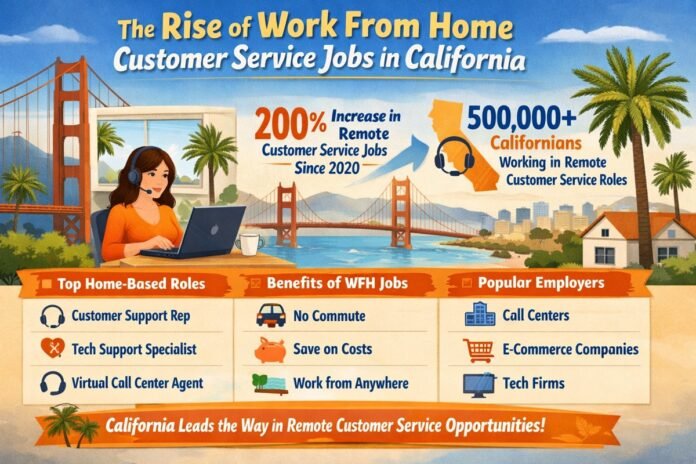
Something significant has happened to the way California companies build and run their customer service teams. Over the past several years, the traditional call center model has given way to a distributed, home-based workforce that is now the dominant structure across e-commerce, healthcare, technology, and financial services. Work from home customer service jobs in California are no longer a fringe option. They are the new standard.
This shift did not happen overnight, and it is not reversing. The infrastructure, the tools, the employer mindset, and the workforce expectations that support remote customer service have all matured to the point where returning to a fully in-office model would be a step backward for most companies.
For job seekers in California, this evolution represents one of the most consistently accessible career opportunities available right now. Whether you are entering the workforce for the first time, switching careers, or looking to move into a more flexible role, understanding this market gives you a clear advantage.
This article covers what work from home customer service jobs actually are, why they are rising so rapidly in California, what skills and tools the roles require, what they pay, and where the market is heading. By the end, you will have a complete picture of this growing sector and how to position yourself within it.
What Are Work From Home Customer Service Jobs
Work from home customer service jobs are positions where employees or contractors assist customers entirely from a home-based setup, using a computer, phone, and internet connection instead of reporting to a physical office or call center.
These home-based customer service jobs span multiple support channels, each suited to different communication styles and employer needs:
- Phone support: Handling inbound calls from customers who need help with orders, billing, technical issues, or account management
- Email support: Responding to customer inquiries submitted through a help desk or contact form, typically managed through a ticketing system
- Live chat: Managing real-time text conversations on a company website or mobile app, often handling multiple simultaneous chats
- Social media support: Responding to customer complaints and questions submitted through platforms like Twitter, Facebook, or Instagram
- Video support: A growing channel used by tech companies and healthcare providers for more complex or personalized support interactions
Common job titles in this space include Customer Support Representative, Remote Call Center Agent, Live Chat Specialist, Technical Support Agent, Customer Success Associate, and Member Services Representative. The variety of titles reflects how broadly this type of work is distributed across industries.
Why Work From Home Customer Service Jobs Are Rising in California
The growth of remote customer service jobs in California is driven by several interconnected factors. Understanding them helps job seekers recognize why this is a long-term trend rather than a temporary phase.
Digital Transformation of Businesses
California companies across every sector have invested heavily in moving their operations online. Banking apps replaced bank branches for millions of routine transactions. Telehealth platforms replaced clinic visits for basic consultations. Subscription software replaced boxed products for business tools. Every one of these digital shifts created a new customer touchpoint that requires support.
As businesses digitized their services, they also digitized their support infrastructure. Customer service moved out of physical call centers and into cloud-based platforms that agents can access from anywhere. This transition made remote hiring not just possible but operationally preferable for most organizations.
Growth of eCommerce and SaaS
California is home to a disproportionately large number of e-commerce brands and software companies, both of which generate exceptionally high demand for customer support. An e-commerce company processing thousands of orders per day needs agents available around the clock to handle shipping questions, returns, refunds, and account issues. A SaaS company with a global subscriber base needs support staff distributed across time zones to provide coverage without overloading a single team.
Both of these business models scale much more efficiently with remote teams than with physical call centers. The result is a steady and growing supply of online customer support jobs from California-based companies that are hiring across the state and beyond.
Post-Pandemic Work Culture Changes
The widespread adoption of remote work during the early 2020s fundamentally changed what both employers and employees expect from a job arrangement. Companies that were forced to manage remote customer service teams for the first time discovered that productivity, quality, and employee satisfaction were all manageable, and in many cases improved, in a distributed model.
Workers, meanwhile, experienced the benefits of working from home firsthand and began prioritizing flexibility as a non-negotiable factor in job decisions. This cultural shift is now baked into the job market. Employers who remove remote work options face higher turnover and greater difficulty attracting qualified candidates, which incentivizes them to maintain and expand their remote hiring programs.
Cost Efficiency for Companies
The financial logic of remote customer service teams is compelling. Eliminating or reducing physical call center space saves on rent, utilities, equipment, and the wide range of operational costs associated with managing a large in-office workforce. In California, where commercial real estate costs in major metros are among the highest in the country, these savings are particularly significant.
Remote hiring also allows companies to recruit from lower cost-of-living areas of the state, balancing compensation budgets without sacrificing quality. A company headquartered in San Francisco can hire experienced agents in Bakersfield or Fresno at wage levels that reflect local economic conditions while still meeting California’s minimum wage requirements.
Benefits of Work From Home Customer Service Jobs
For Employees
- Flexibility: Remote roles often offer more control over scheduling, especially in contractor models where agents choose their own hours. This flexibility is particularly valuable for caregivers, students, and people managing health-related needs.
- No commute: Eliminating a daily commute saves California workers significant time and money. In the Los Angeles metro area, average commute times exceed 30 minutes each way. That is more than 200 hours per year returned to the worker simply by removing the drive.
- Better work-life balance: Workers in remote roles consistently report higher job satisfaction and lower stress levels compared to in-office counterparts. The ability to control the work environment, take breaks on a natural schedule, and spend more time with family contributes directly to this improvement.
- Access to more job opportunities: Before remote work became standard, a customer service job seeker outside of a major California city had limited options. A candidate in a rural or suburban area now has access to the same roles as someone in downtown Los Angeles or the San Francisco Bay Area.
For Employers
- Wider talent pool: Remote hiring removes geographic restrictions, allowing companies to recruit from across California and source candidates with the specific language skills, industry knowledge, or experience levels they need
- Lower costs: Reduced facility expenses, lower equipment overhead, and competitive wage structures in lower-cost regions all contribute to a more efficient cost model for remote support teams
- Increased productivity: Studies consistently show that remote workers in structured roles produce results comparable to or better than in-office counterparts, with lower absenteeism and higher retention rates when flexibility is offered
Technology Powering Remote Customer Service Roles
The digital customer service workforce in California is built on a layer of technology that makes distributed teams as functional as centralized ones. Understanding these tools is important for any job seeker entering this space.
- CRM tools like Zendesk and Salesforce: Customer relationship management platforms are the operational center of any remote support team. They store customer histories, manage open tickets, track interaction data, and allow agents to collaborate without being in the same room. Employers across every industry rely on these platforms, and familiarity with them is among the most valued qualifications a candidate can have.
- Cloud-based communication tools: Platforms like RingCentral, Zoom, Microsoft Teams, and Slack keep remote agents connected to supervisors, teammates, and escalation channels in real time. Training, performance reviews, team huddles, and one-on-one coaching all happen through these tools without requiring anyone to be in the same location.
- AI and automation in customer support: Artificial intelligence is being integrated into customer service workflows at a rapid pace. Chatbots handle routine Tier 1 inquiries automatically, freeing human agents to focus on complex or emotionally sensitive interactions. AI tools also assist agents in real time by surfacing relevant knowledge base articles, suggesting responses, and flagging escalation risks. Rather than replacing remote agents, this technology is making them more effective and increasing the value of the human judgment they bring to each interaction.
Most In-Demand Work From Home Customer Service Roles
Within the broader category of remote support careers, several specific roles are seeing the strongest hiring activity in California right now.
- Customer Support Representative: The most widely available role in the field. These agents handle inbound inquiries across multiple channels, resolve account issues, process transactions, and escalate complex problems to senior teams. It is the most common entry point into remote customer service.
- Remote Call Center Agent: Focused primarily on inbound phone support, these roles are in strong demand in healthcare, insurance, telecom, and financial services. They require clear verbal communication and the ability to stay composed during high-volume call periods.
- Live Chat Support Agent: One of the fastest-growing virtual customer service roles in e-commerce and SaaS. Agents manage multiple simultaneous text conversations, resolve issues quickly, and maintain a professional tone in writing. Strong typing speed and written communication skills are essential.
- Technical Support Specialist: These agents assist customers with software, hardware, or platform-specific issues. The role requires a deeper understanding of technology and pays more than standard customer service positions. Demand is especially strong among California’s large technology company base.
- Customer Success Associate: Found primarily in SaaS and subscription businesses, customer success associates focus on proactively ensuring customers are getting value from a product. They conduct onboarding calls, monitor account health, and work to prevent cancellations before they happen. This role bridges customer service and account management and is among the higher-paying options in the remote support category.
Skills Required to Succeed
Technical Skills
- CRM software: Proficiency in Zendesk, Salesforce, Freshdesk, or HubSpot is expected by most employers hiring for remote roles. Free training is available online for each of these platforms and completing even a basic course adds immediate value to your resume.
- Ticketing systems: Familiarity with Help Scout, Intercom, or similar tools is expected for email and chat support roles. Understanding how to manage a queue, prioritize tickets, and track resolution time is a practical skill that translates directly to performance metrics.
- Basic troubleshooting: For technical support roles especially, the ability to walk a customer through diagnostic steps, identify the likely cause of a problem, and present a solution clearly is a valued skill that increases both your earning potential and your career options.
Soft Skills
- Communication: Every customer service interaction is a communication task. Whether you are writing an email reply, handling an inbound call, or navigating a live chat conversation, the ability to express yourself clearly, professionally, and empathetically is the foundation of everything else.
- Problem solving: Customers contact support when something has gone wrong. The ability to think through the issue systematically, stay calm under pressure, and arrive at a practical solution is what separates effective agents from average ones.
- Empathy: A customer who feels genuinely understood and cared for is far more likely to remain a loyal customer, even after a negative experience. Empathy is not just a soft quality. It is a measurable driver of customer satisfaction scores and retention outcomes.
- Time management: Remote work requires self-discipline. Managing a ticket queue, meeting response time targets, and staying productive throughout a shift without direct supervision demands strong personal organization and the ability to prioritize effectively.
Salary Trends in California
Pay rates for work from home customer service jobs in California reflect the state’s higher minimum wage, cost of living, and the growing competition among employers for skilled remote agents.
- Entry level pay: $16 to $22 per hour, or approximately $33,000 to $46,000 per year. Most entry-level roles include paid onboarding and some employers provide equipment or internet reimbursement to help new hires set up their home workspace.
- Mid level salary ranges: $22 to $32 per hour, or $46,000 to $66,000 per year. Candidates with 2 to 4 years of relevant experience and demonstrated CRM proficiency typically fall within this range, especially those with consistent satisfaction score records.
- Experienced roles: $32 to $50 per hour, or $66,000 to $104,000 per year for senior agents, team leads, technical support specialists, and customer success managers at technology and healthcare companies.
- Bonuses and incentives: Performance-based bonuses tied to customer satisfaction scores, first-contact resolution rates, and monthly ticket volume are standard at many mid-to-large employers. Bilingual agents fluent in Spanish and English consistently earn a pay premium of $1 to $4 per hour above the base rate, reflecting high demand for bilingual support across California.
Challenges of Working From Home in Customer Service
A complete picture of this field includes an honest look at the challenges remote agents face. Understanding these upfront helps you prepare for them rather than be caught off guard.
- Isolation: Working alone at home removes the natural social interaction of a shared workplace. For some agents, particularly those transitioning from in-office environments, this isolation becomes a source of disengagement over time. Building a daily routine, staying active in virtual team channels, and scheduling regular breaks helps offset this significantly.
- Handling customer issues remotely: De-escalating an upset customer without the benefit of face-to-face interaction is genuinely harder than doing so in person. You cannot read body language, use physical gestures, or leverage the natural warmth of an in-person encounter. Developing strong verbal and written empathy skills is essential for remote agents who handle high-emotion interactions regularly.
- Maintaining productivity: Home environments come with distractions that offices do not. Family members, household responsibilities, and the absence of a structured workplace rhythm can all undermine focus. Establishing a dedicated workspace, setting clear working hours, and using productivity techniques like time-blocking makes a meaningful difference.
- Work-life boundaries: When your home is also your office, the line between work time and personal time can blur. Remote agents in high-demand roles sometimes find it difficult to disconnect at the end of a shift. Setting firm boundaries around working hours and shutting down work tools when the shift ends is a habit worth building from the start.
Future of Work From Home Customer Service Jobs
The trajectory for remote call center jobs in California and the broader remote support sector points clearly in one direction: continued and accelerating growth.
- Continued growth in remote hiring: The infrastructure companies have built for remote customer service teams is not being dismantled. It is being expanded. Employers who have seen the operational and financial benefits of distributed support models are investing further in remote hiring programs, not pulling back from them.
- Integration of AI tools: Artificial intelligence will continue to reshape how remote customer service works, but it will not replace human agents. It will handle routine, repetitive queries automatically and support human agents with real-time information and suggestions. The agents who thrive in this environment will be those who develop the judgment, empathy, and communication skills that AI cannot replicate.
- Rise of specialized support roles: As industries like fintech, healthtech, legal tech, and edtech grow their remote operations, there will be increasing demand for agents with specific domain knowledge. These specialized roles pay more, offer clearer career development paths, and are becoming increasingly available to California-based remote workers.
Conclusion
The rise of work from home customer service jobs in California is the product of real, durable forces: digital transformation, e-commerce growth, cultural shifts in how people work, and the financial logic that makes remote teams attractive to employers at every scale. These are not temporary conditions. They are the new normal.
For job seekers, the opportunity this creates is substantial and accessible. Entry-level roles provide a clear starting point, and the career path from there is real for those who build their skills, learn the right tools, and deliver consistent results. From live chat agents earning $18 per hour to customer success managers earning six figures, the range within this single category is broader than most people recognize.
California’s market for remote support careers is active, competitive, and growing. If this is a path you are considering, the best time to start is now. Update your skills, explore the platforms where these roles are posted, and take the first step toward a career that offers both stability and genuine long-term potential.
