

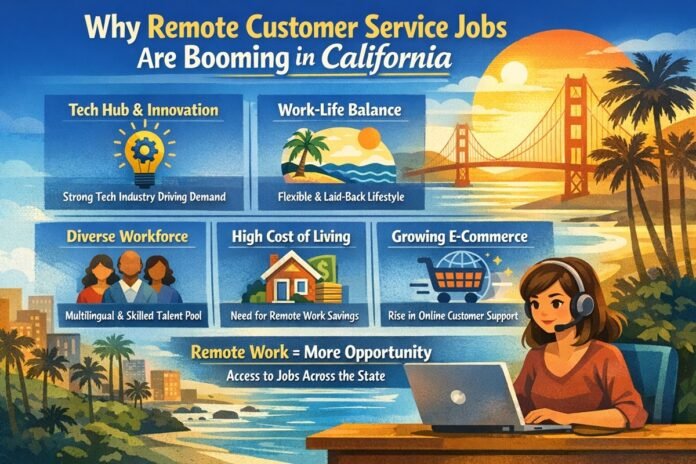
Remote work has moved from a temporary solution to a permanent fixture in the American workforce, and nowhere is this more visible than in California. Across the state, companies are building distributed support teams, eliminating physical call centers, and posting thousands of remote customer service jobs in California every single month.
Customer service roles are leading this remote work shift in a way that few other job categories are. They are among the most scalable, most easily managed, and most in-demand positions in a fully remote structure. For job seekers, this represents one of the most accessible and stable career opportunities available today.
This article breaks down exactly why remote customer service jobs are booming in California. You will learn what is driving the growth, which types of roles are expanding fastest, what skills employers want, and what the future holds for this sector. Whether you are considering entering this field or already working in it, understanding these trends will help you make smarter career decisions.
The Shift Toward Remote Work in California
California was already a leader in progressive workplace policies before the widespread adoption of remote work. The events of the early 2020s accelerated a shift that was already underway, and what started as a necessity quickly became a preference for both employers and workers.
Digital transformation played a major role in making this shift permanent. Companies that had been hesitant to move their customer service operations online were forced to adapt quickly, and most discovered that their agents were just as effective, sometimes more so, working from home. The infrastructure built during that period, including cloud-based software, remote management tools, and digital training platforms, did not disappear when offices reopened. It became the foundation for a new way of working.
Today, California companies across nearly every industry have adopted remote hiring as a standard model rather than an exception. Large enterprises use it to reduce costs. Startups use it to access talent outside major metro areas. Mid-size companies use it to compete for skilled workers who now expect flexibility as a baseline condition of employment.
The result is a labor market where work from home customer support jobs are not a niche category. They are mainstream, stable, and growing year over year.
Growth of eCommerce and SaaS Companies
Two industries in particular have been the biggest engines behind the boom in remote call center jobs in California and virtual customer support roles: e-commerce and software as a service (SaaS).
E-commerce companies require constant, high-volume customer support. Customers shop at all hours, orders go wrong, products get delayed, and questions need answers immediately. Building a physical call center to handle this is expensive and inflexible. Remote agent teams, by contrast, can be scaled up or down quickly, spread across time zones to cover 24-hour windows, and hired without the overhead of office facilities.
SaaS companies face a different but equally demanding support need. Their customers are often businesses themselves, paying monthly or annual subscription fees. When a product issue arises, the customer expects fast, knowledgeable help. SaaS companies invest heavily in customer success and support teams because retaining a subscriber is far more cost-effective than acquiring a new one. These roles are almost always remote and tend to pay above the average for traditional customer service positions.
California is home to a disproportionate share of both e-commerce and SaaS companies. That concentration of digital-first businesses means the demand for online customer service jobs in this state is significantly higher than in most other parts of the country.
Cost Savings for Companies
One of the most straightforward reasons companies continue to expand their remote customer service hiring is simple economics. Running a physical call center is a significant financial commitment. Remote teams eliminate or dramatically reduce those costs.
- Reduced office space costs: A company that employs 100 remote agents saves the lease, utilities, equipment, and maintenance costs of a facility large enough to house them all. For California-based companies operating in high-cost cities like San Francisco or Los Angeles, these savings are substantial.
- Lower operational expenses: On-site support operations require supervisors, facilities managers, break room upkeep, parking, security, and a range of other expenses that remote teams simply do not generate.
- Access to a wider talent pool: Remote hiring removes geographic restrictions. A company in San Francisco can hire a skilled agent in Fresno, Bakersfield, or any other part of California where the cost of living and wage expectations may be lower. This flexibility makes it easier to build a strong team at a manageable budget.
For businesses weighing the cost of growth, remote customer service teams offer a compelling combination of quality, scalability, and savings that physical operations simply cannot match.
Benefits for Employees
The boom in remote customer service jobs is not only good for companies. It represents a genuine improvement in quality of life for the workers who fill these roles.
- Work from home flexibility: The ability to work from home gives employees more control over their daily environment, their schedule, and how they structure their work day. For caregivers, parents, and people managing health challenges, this flexibility is transformative.
- Reduced commute time: In California, where commutes in major metro areas can easily exceed one to two hours each way, eliminating the commute saves workers significant time, money, and stress every single week.
- Better work-life balance: Remote workers consistently report higher job satisfaction and better overall wellbeing compared to in-office counterparts in similar roles. The absence of a commute, greater autonomy, and a more comfortable work environment all contribute to this.
- Access to more job opportunities: Before remote work became standard, a customer service job seeker in a rural area of California had very limited options. Remote hiring removes that barrier entirely. A candidate in a small town now has access to the same opportunities as someone living in a major city.
These benefits create a self-reinforcing cycle. Workers seek out remote roles, which pushes more employers to offer them, which increases the volume of remote positions available across the state.
Technology Enabling Remote Customer Service Jobs
Remote customer service at scale would not be possible without the technology that supports it. The tools available in 2026 make it easier than ever for distributed teams to operate with the same efficiency as in-office counterparts.
- CRM tools like Zendesk and Salesforce: These platforms allow agents to access full customer histories, log interactions, manage tickets, and collaborate with teammates from anywhere with an internet connection. They are the operational backbone of virtually every remote customer service team.
- Cloud-based communication platforms: Tools like RingCentral, Zoom, and Microsoft Teams keep remote agents connected to their supervisors and colleagues without requiring anyone to be in the same physical location. Team meetings, training sessions, and one-on-one coaching all happen seamlessly in the cloud.
- AI-assisted customer support systems: Artificial intelligence is increasingly being used to handle routine inquiries through chatbots and automated response systems. Rather than replacing human agents, this technology handles Tier 1 queries so that remote agents can focus on more complex, higher-value interactions. This raises the value of skilled human agents and, in many cases, increases their earning potential.
As these tools continue to improve, the case for remote customer service teams only grows stronger. Employers have less reason than ever to require physical presence for support roles.
Types of Remote Customer Service Jobs Growing Fast
Within the broader category of remote customer service, certain roles are experiencing particularly strong growth in California right now.
- Customer Support Representative: The most common entry point into the field. These agents handle inquiries across phone, chat, and email and are in consistent demand across nearly every industry. The volume of open positions for this role is higher than any other in the remote customer service space.
- Remote Call Center Agent: Inbound call center roles remain in strong demand, particularly in healthcare, financial services, and telecom. As companies continue moving their call center operations fully remote, the number of available positions for California-based agents is growing steadily.
- Live Chat Support Agent: The growth of e-commerce and app-based businesses has created a surge in demand for agents who handle real-time chat conversations. This role appeals to workers who prefer written communication and is one of the fastest-growing remote support categories.
- Technical Support Specialist: As more consumers use technology products and software services, the need for agents who can troubleshoot and resolve technical issues remotely has grown significantly. These roles pay more than standard customer service positions and are in strong demand across California’s large technology sector.
- Customer Success Manager: This role focuses on long-term client relationships rather than reactive support. Customer success managers proactively engage customers to ensure they are getting value from a product, which directly reduces churn for SaaS and subscription businesses. It is one of the highest-paying remote roles in the customer service category.
Skills Driving Demand in 2026
Technical Skills
- CRM software: Employers consistently prioritize candidates who are familiar with platforms like Zendesk, Salesforce, or HubSpot. Even basic familiarity with one of these tools makes a candidate significantly more attractive to hiring managers.
- Chat and ticketing tools: Proficiency in systems like Freshdesk, Intercom, or Help Scout is increasingly expected rather than optional, especially for roles that involve live chat or email support.
- Basic technical troubleshooting: For technical support and SaaS customer service roles, the ability to diagnose simple software or connectivity issues independently is a skill that commands higher pay and opens doors to more specialized positions.
Soft Skills
- Communication: Whether written or verbal, clear and professional communication is the single most important skill for any customer service agent. Remote roles place an even greater emphasis on this because the quality of your communication is the only thing a customer experiences.
- Problem solving: Customers reach support teams when something has gone wrong. The ability to think through a problem calmly, identify the root cause, and present a solution confidently is what differentiates effective agents from average ones.
- Empathy: Remote customer service removes the face-to-face element, which makes emotional intelligence even more important. Agents who can make a frustrated customer feel genuinely heard and supported achieve higher satisfaction scores and stronger retention outcomes.
- Adaptability: Remote teams evolve quickly. New tools get introduced, client priorities shift, and workflows change. Agents who adapt quickly to new systems and expectations are consistently rated higher by supervisors and promoted more often.
Salary Trends in California
The financial picture for remote customer service roles in California reflects both the state’s higher cost of living and the growing competition among employers for skilled remote agents.
- Entry level: $16 to $22 per hour for phone, chat, and email support roles. Annualized, this translates to approximately $33,000 to $46,000 per year. Most entry-level positions include paid training, and some employers provide equipment or internet stipends.
- Mid level: $22 to $32 per hour for agents with 2 to 4 years of experience, strong CRM proficiency, and consistently high customer satisfaction scores. Annual equivalent of $46,000 to $66,000.
- Experienced roles: $32 to $50 per hour for senior agents, team leads, technical support specialists, and customer success managers at technology companies. The upper end of this range, annualized, exceeds $100,000 for high-performing individuals at top-tier employers.
- Bonuses and incentives: Performance bonuses tied to satisfaction scores, first-call resolution rates, and ticket volume are common at mid-to-large employers. Bilingual agents, particularly those fluent in Spanish and English, regularly earn a pay premium of $1 to $4 per hour above standard rates.
Challenges of Remote Customer Service Jobs
The boom in remote customer service is real, but a balanced view requires acknowledging the challenges that come with working in this field from home.
- Isolation and lack of team interaction: Working alone at home removes the natural social energy of an office environment. Some agents find this demotivating over time, particularly those who thrive on in-person collaboration. Companies are addressing this through virtual team meetings, chat channels, and online recognition programs, but the challenge is real.
- Managing time and productivity: Without the structure of a physical workplace, some remote workers struggle with maintaining consistent focus and meeting productivity targets. Building a clear daily routine, designating a dedicated workspace, and using time-blocking techniques can help significantly.
- Handling difficult customers remotely: De-escalating a frustrated customer is never easy, but doing it over the phone or through chat, without body language or visual cues to guide the interaction, adds an extra layer of difficulty. This is a skill that takes time and practice to develop effectively.
Future Outlook for Remote Customer Service Jobs
Looking ahead, the trajectory for remote customer service careers from home in California is strongly positive. Several trends point to continued and accelerating growth over the next several years.
- Continued growth in remote hiring: Companies that have invested in remote infrastructure are unlikely to reverse course. The cost savings, talent access, and operational flexibility are too significant. Remote customer service hiring is expected to remain a major employment category through the rest of the decade.
- Increased use of AI tools: Artificial intelligence will continue to reshape how customer support works. Routine queries will be handled by automated systems, and human agents will increasingly focus on complex, emotionally nuanced interactions that require real judgment and empathy. This shift raises the value of skilled human agents rather than reducing it.
- More specialized customer support roles: As industries like healthcare, fintech, and legal tech grow their remote operations, there will be increasing demand for agents with domain-specific knowledge. Specialized roles command higher pay and offer stronger long-term career development than generalist support positions.
Conclusion
The reasons why remote customer service jobs are booming in California are deep and structural. Digital business growth, cost efficiency, technology maturation, and worker preference have combined to create a job market where virtual support roles are not just common, they are one of the most reliably available career options in the state.
For job seekers, this represents a genuine long-term opportunity. Entry-level positions provide an accessible starting point, and the career path is clear for those who develop their technical skills, build domain knowledge, and consistently deliver results. From live chat agents earning $18 per hour to customer success managers earning six figures, the range of possibilities within this one category is broader than most people realize.
If you have been considering a career in remote customer service, the conditions in California right now are as favorable as they have ever been. The companies are hiring, the tools are accessible, and the demand is not slowing down. Take the time to understand the landscape, build the right skills, and position yourself for a role that offers both stability and growth in one of the most dynamic job markets in the country.
